Every serious motorcycle racing suit mentions CE Level 2 certification — but most riders don’t fully understand what it means, what it tests, or why the difference between Level 1 and Level 2 matters in a real crash. This guide explains the CE protection standard clearly so you can make an informed decision when buying your next custom motorcycle racing suit.
What Is CE Certification?
CE marking stands for Conformité Européenne — a European safety standard that indicates a product meets specific protection requirements. For motorcycle gear, CE certification is governed by standard EN 13594 for gloves and EN 1621 for body armor used in jackets and suits.
CE certification for motorcycle suit armor is split into two performance levels: Level 1 and Level 2. Both levels are tested using the same method — dropping a weighted striker onto the armor from a standardized height and measuring how much impact force transmits through to the body underneath.
CE Level 1 vs CE Level 2 — The Actual Difference
CE Level 1 armor must transmit no more than 35kN (kilonewtons) of force on average during the impact test, with no single reading exceeding 50kN.
CE Level 2 armor must transmit no more than 20kN of force on average, with no single reading exceeding 30kN.
In plain terms: CE Level 2 armor absorbs significantly more impact energy than Level 1. The difference isn’t marginal. A Level 2 certified shoulder protector dissipates considerably more crash force than a Level 1 equivalent — and in a high-speed crash, that difference is what determines the severity of an injury.
Which Body Zones Are Covered?
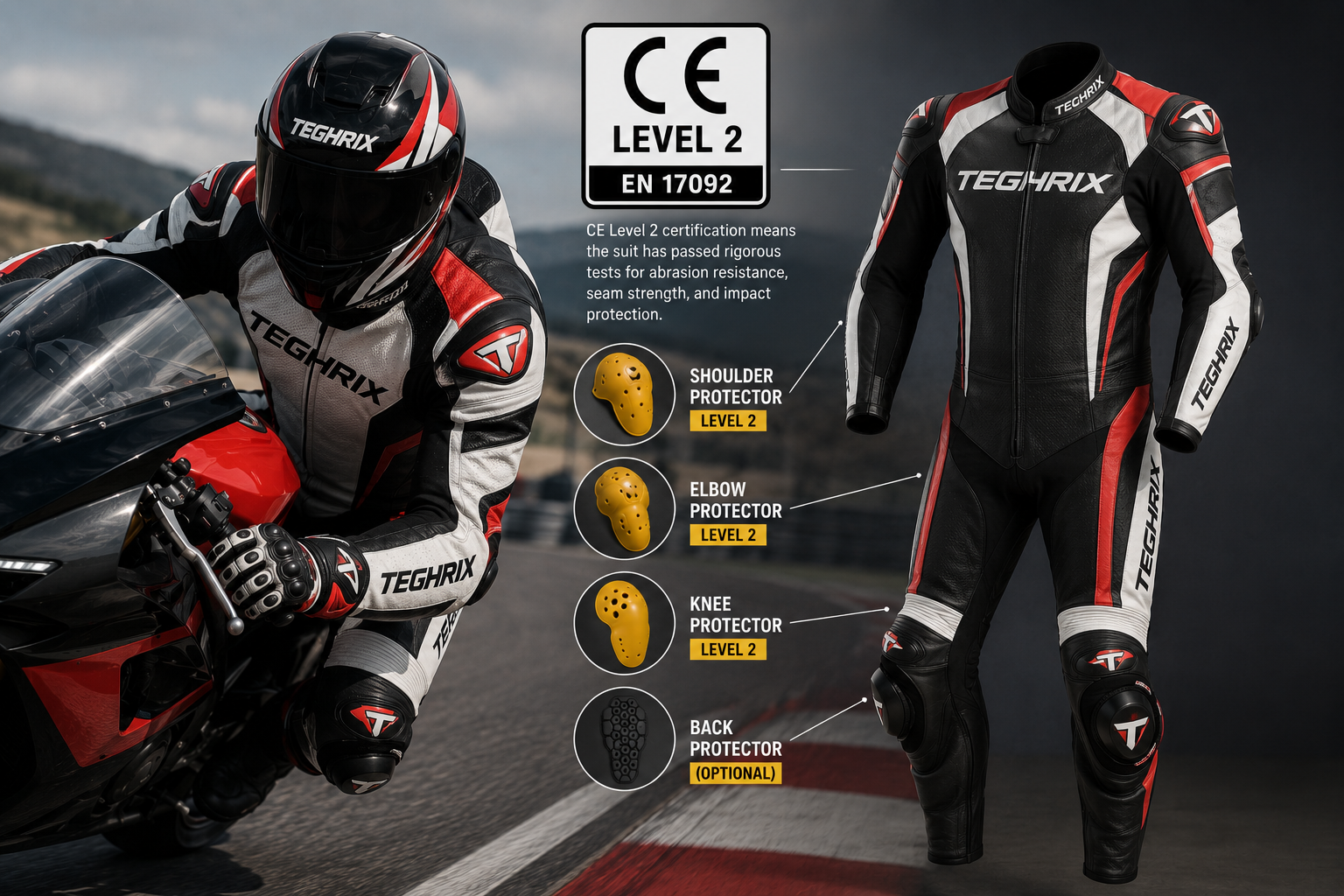
In a motorcycle racing suit, CE certified armor is placed at specific impact zones identified as high-risk in crash analysis research:
- Shoulders — one of the most common first-contact points in a crash
- Elbows — high risk in both low and high-speed falls
- Knees — critical in any fall involving the lower body
- Hips — standard in two-piece suits and some one-piece designs
- Back — via a separate back protector insert pocket
At Teghrix, every suit is built with CE Level 2 certified armor at shoulders, elbows, and knees as standard. Back protector pockets are pre-fitted and sized for Level 2 back protectors, which we recommend purchasing separately to complete your protection setup.
Why CE Level 2 Matters on a Track
At track day speeds, even a low-side fall at 60mph generates enormous impact forces. Standard CE Level 1 armor is designed to provide protection — but Level 2 is specifically engineered for the higher energy impacts common in real racing environments.
Many circuits and racing organizations now require CE Level 2 certification as a minimum standard for riders participating in track days. If you’re planning to ride on circuit, always check the specific requirements of the event — and buy to the higher standard so you’re never turned away from the pit lane.
How to Check CE Certification on a Suit
Certified armor must be labelled with the CE mark, the standard number (EN 1621-1 for limb armor, EN 1621-2 for back protectors), the protection level (1 or 2), and the manufacturer’s details. Armor without this labelling is not certified — regardless of what the product description claims.
When you purchase a Teghrix suit, the CE Level 2 certification documentation for each armor component is included with your order. You can verify each piece independently.
Does CE Level 2 Mean the Suit Is Safer Overall?
CE Level 2 armor is a critical factor in suit safety — but it’s not the only one. The leather construction, stitching quality, and how the suit fits your body also determine how protection performs in a real crash.
A CE Level 2 armor set in a poorly fitting suit won’t protect you as well as the same armor in a suit built precisely for your body. This is the core argument for custom motorcycle racing suits over off-the-shelf gear — not just the armor rating, but the armor placement accuracy that comes from a suit built to your measurements.
CE Level 2 and Airbag Compatibility
An emerging category in motorcycle protection is airbag-integrated suits, which combine CE armor with an airbag system that deploys on crash detection. Airbag systems work alongside CE armor rather than replacing it — the airbag provides additional cushioning at the moment of impact, while the CE Level 2 armor continues to absorb and distribute force throughout the crash sequence.
Teghrix suits are constructed to be compatible with airbag vest systems worn underneath. Contact us if you’re planning to use an airbag vest and we’ll build the suit with the appropriate clearance and construction adjustments.
Summary: What to Look for When Buying
- CE Level 2 certified at shoulders, elbows, and knees — as a minimum
- CE Level 2 back protector pocket pre-fitted — or Level 2 back protector included
- Armor labelled with EN 1621-1 (limb) and EN 1621-2 (back) standards
- Suit built to your measurements so armor sits correctly over each impact zone
- Certification documentation included with order
→ All Teghrix custom motorcycle racing suits include CE Level 2 certified armor as standard. Visit our CE Certification page for full specification details, or browse our suit range.